
MARCIEGAMBETTA
Marcie Gambetta
English 231
I Ching
Hexagrams 19-34
Reading Journal 9
9/30/14
FIRST THOUGHTS
My first thoughts about reading the next section of hexagrams were not that happy. Usually, after reflecting on things I don't understand, clarity will come. Not so this time, I am still confused. I scanned through the section and saw more of the same. So, I had to do more research, buckle down and get the reading done.
QUOTES
From Hexagram 30 - “What is dark clings to what is light and so enhances the brightness of the latter. A luminous thing giving out light must have within itself something that perseveres; otherwise it will in time burn itself out.”.
I liked the first sentance of this quote, but I did think it was a little obvious. A light, lit in the day time will not look as bright compared to when the same light is used at dusk, and the same light used at dusk will not look as bright compared to the same light used in the darkness of night. The darker the surroundings, the brighter the light looks. So, if you are good and surrounded by good people you will not look exceptionally good. Using the same goodness, surround yourself with bad people and you will look extraordinarily good. However, if you are good (a luminous thing giving out light) you must have an inner tenacity to persevere, otherwise the bad (darkness) will overtake you and you will no longer shine. This reminds me of the saying "It is easier to drag someone down, than pull them up."
From Hexagram 34 - "Making a boast of power leads to entanglements, just as a goat entangles its horns when it butts against a hedge. Whereas an inferior man revels in power when he comes into possession of it, the superior man never makes this mistake. He is conscious at all times of the danger of pushing ahead regardless of circumstances, and therefore renounces in good time the empty display of force."
This quote reminds me of the saying "With power, comes great responsibility." People are being warned here, not to be haughty when you are in a position of power. It seems to be using its words to trick you, like you are a little kid and can't recognize what it is doing. By saying if you are inferior then you will revel in your power, but if you are superior then you will not, and you will not rush ahead using your power unnecessarily. No one wants to be inferior, we want to be superior so we become conscious of the danger of power when we weren't necessarily before. It is a self-fulfilling prophecy.
QUESTIONS
What is yarrow?
Yarrow is a flowering plant with flat flower heads and lacy leaves. Yarrow is a medicinal herb and is used in alternative medicine. The flowers of the plant are dried and used in floral arrangements. The stalks are the trunk part of the plant and those are what is used for divination.
What else did the ancient Chinese do to read the future?
The turtle shell oracle is probably the earliest record of fortune telling. The diviner would apply heat to a piece of a turtle shell (sometimes with a hot poker), and interpret the resulting cracks. The cracks were sometimes annotated with inscriptions. These inscriptions are the oldest Chinese writings that have been discovered. This method predated the earliest versions of the I Ching by hundreds of years.
VOCABULARY
Trigram:
Definition: a sequence of three adjacent letters or symbols.
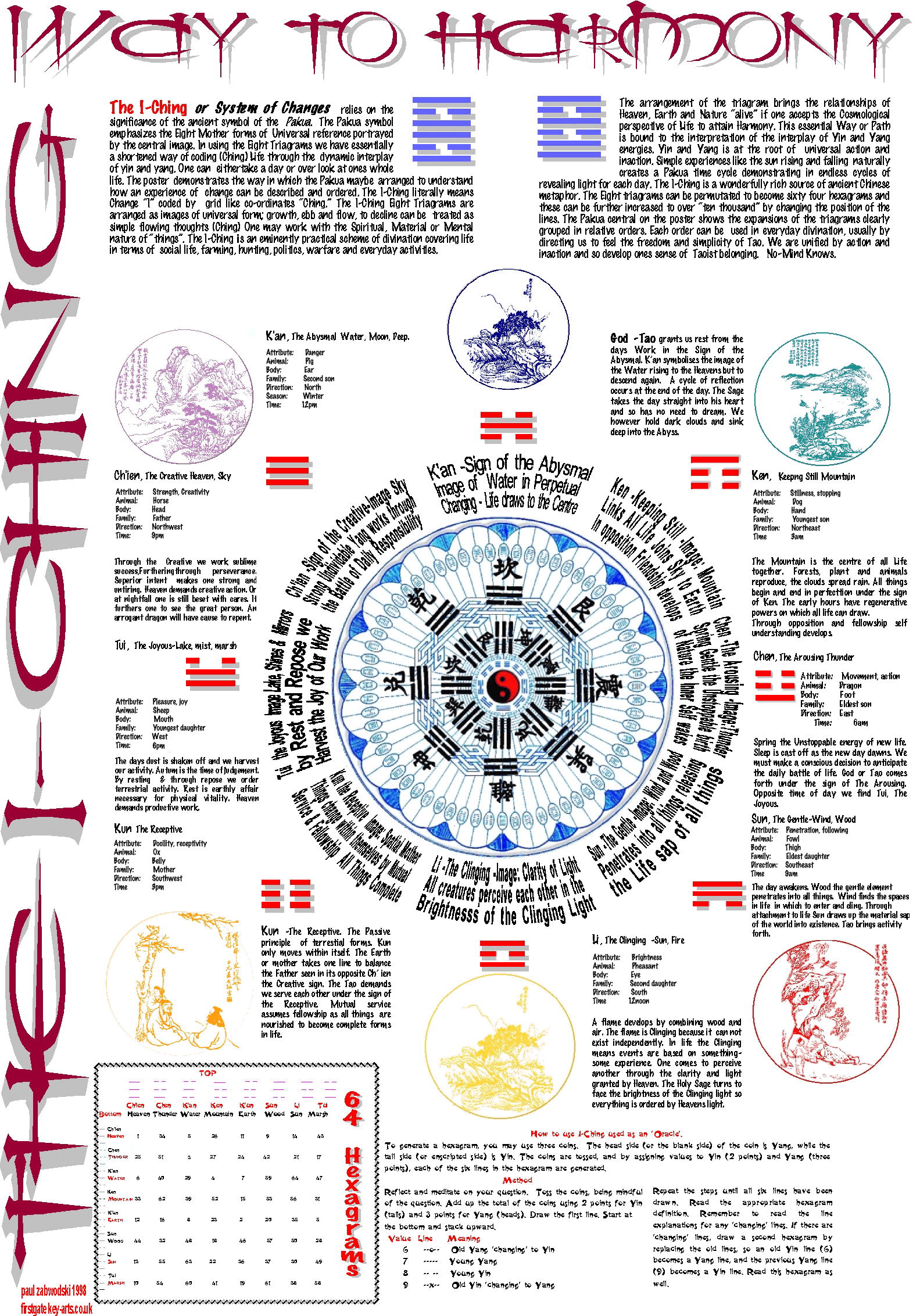
Sentence: The I Ching uses hexagrams, which are made up of trigrams, for divination.
Qian:
Definition: to observe with contemplation; those above will present a model for those below
Sentence: "Joe always takes the time to observe his surroundings and contemplate, when he does something it is always a good example to all, by doing this he demonstrates the qualities of Guan."
Yin:
Definition: negative, dark, and feminine; interaction with yang is thought to maintain the harmony of the universe and to influence everything within it
Sentence: Working together, yin and yang achieve balance.
SUMMARY/RESPONSE
Today, I was not looking forward to the reading. This was kind of a downer because, I love to read, I read constantly and voraciously. Nevertheless, I put my head down and persisted. I still feel like we are reading lines, and I would prefer to come up with my own conclusion as to the meaning instead of reading someone else's intrepretation. As I lumbered along with the reading, I was able to make a little more sense of it than with the previous group.
After reading hexagrams 19-34, I thought a lot of the proclamations were self fulfilling. Take this quote from Hexagram 27, for example "He who cultivates the inferior parts of his nature is an inferior man. He who cultivates the superior parts of his nature is a superior man". Of course...If you focus on your negative side and give all attention to that you will be negative, If you focus your attention on your positive side and nurture that you will be more positive. These may seem to some like "profound truths" but are actually common sense.
As with yesterday, many of the statements are open ended, the results depend on the actions of the person. Hexagram 19 says "It is well to join this upward trend, but we must not let ourselves be carried away by the current of the time; we must adhere perseveringly to what is right. This bring[s] good fortune". This is saying, if you do what is "right" you will get "good fortune. Logically then it follows that, if you do wrong you will bring mistfortune. So if you are not fortunate you must be doing wrong or be a bad person. This may not be the case, but if you are a follower of this then you will think that. Others who follow this will also think that, and you could be shamed publicly when you might only be a victim of circumstance. Consider a hypothetical situation in the context of this quote, a tornado strikes and levels a house. What would followers of this philosphy will think? That the person deserved this and brought it upon himself. Also, there are no clear guidelines for "right" it is all up the individual's morality, which could vary wildly from another person's morality.
The literary theme that stood out to me this time was “Man Struggles Against Societal Pressure”. The hexagrams show ways for people in power to discover how they should behave. They could also used by people in lower positions to learn how to elevate themselves. There are plenty of warnings against acting certain ways but, it is left up to interpretation and translation, which can be different depending on who is doing the reading. Hexagram 22 is a good example of a warning and of people in lower positions learning how to elevate themselves, "A beginner in subordinate place must take upon himself the labor of advancing. There might be an opportunity of surreptitiously easing the way-symbolized by the carriage-but a self-contained man scorns help gained in a dubious fashion. He thinks it more graceful to go on foot than to drive in a carriage under false pretenses."
Another literary theme that was very obvious was "Yin and Yang". Many of the hexagrams have a yin and yang balancing of trigrams within them. For every hexagram that is more yin there is another hexagram that balances it out with yang. The hexagrams often balance nature to spirit, earth to heaven, space to time, male to female, etc. This is very distinct throughout all the text, here is an example from Hexagram 21 "Li is yielding, Chên is hard. Unqualified hardness and excitement would be too violent in meting out punishment; unqualified clarity and gentleness would be too weak. The two together create the just measure". One by itself is too harsh, one by itself is to weak but together they make a great balance. This reminded me of Goldilocks..."This porridge is too hot, this porridge is too cold, this porridge is juuuuust right."
I used the Structuralism and Semiotics School of Literary Analysis to analyze this text. This text is based on symbols that are very structured. In order to divine the future, the symbols must be placed properly and then interpreted. The interpretations include warnings and encouragement to the person. When placed in different ways in relation to each other and the seasons the interpretations can be very different. The organization and structure of the lines and understanding of how they should be used in relation to everything else around them are critical for people to be able to interpret the meaning correctly.
WORKS CITED
Dictionary. Dictionary.com LLC 2014. Retrieved 9/27/14, from http://dictionary.reference.com/
I Ching, translated by Richard Willhelm. Retrieved 9/27/14, from
http://www2.unipr.it/~deyoung/I_Ching_Wilhelm_Translation.html#1
Paranormality I Ching (The Meanings of the 8 Trigrams and 64 Hexagrams). Retrieved 9/27/14,
from http://www.paranormality.com/i_ching_hexagram_meanings.shtml
Russell Cottrell Rules of Interpretation. Retrieved 9/27/14, from
http://www.russellcottrell.com/VirtualYarrowStalks/rules.htm
Unveiling the Mystery of the I Ching. Retrieved 9/27/14, from http://www.iching123.com/1_text.htm
Joyful Movement Yarrow Stalk Farm. Retrieved 9/29/14, from
http://www.joyfulmovement.org/joyfulmovement/Yarrow_Stalk_Farm.html
Photo Credit:
http://www.crystalspirits.biz/CrystalSpiritsInfosite/divination/iching.htm